Parents of bilingual children often worry about their children's language development. Contrary to popular belief, bilingual children are not "delayed" in speech development, and acquiring two languages simultaneously does not negatively impact language and speech development.
We should always remember that for children born or living abroad from birth, Polish is a minority language.
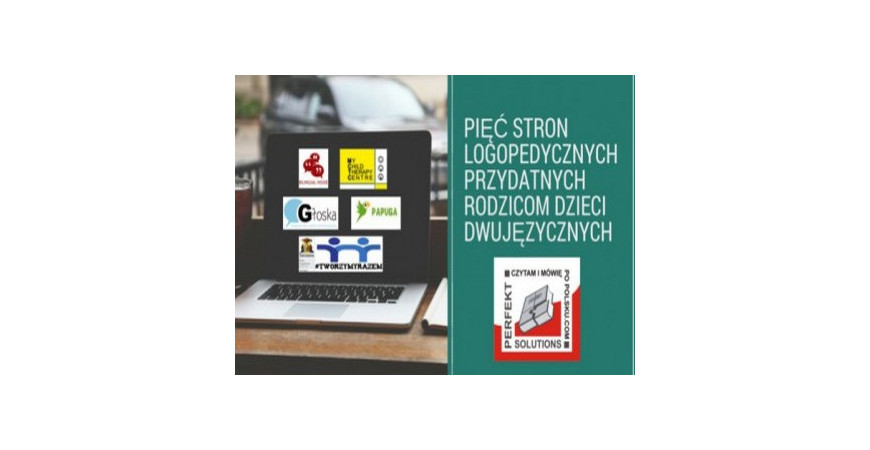
The topic of language development in bilingual children has been very popular for some time now, and the internet is full of useful advice and materials, often of very good quality. That's why today we've gathered speech therapy websites and portals that parents can use to support their children's Polish language development.
1. Bilingual House Portal and Bilingual House Facebook Page
The Bilingual House website is a veritable treasure trove of information for parents of bilingual children. There, you'll find interesting blog posts about common problems faced by bilingual children and practical advice on how to address them. Ms. Aneta discusses topics such as learning to read and write, with particular emphasis on the specific challenges of bilingual children, such as the pronunciation of Polish sounds.
Ms. Aneta describes exercises using her own children raised bilingually and demonstrates that simple and creative exercises can achieve excellent results in bilingual education. Our favorite articles and ideas include the series "Our Language – Our Lessons," full of practical tips for fun language acquisition, such as "Letters to Santa Claus" or words that look similar but mean different things – such lessons ensure learning is never boring!
Bilingual House offers individual consultations with children via Skype, presentations and workshops for schools, and webinars.
We asked Aneta Nott-Bower, author of the Bilingual House website, when should parents of bilingual children consult a speech therapist?
It's worth paying attention to the following warning signs, and if you're concerned about your bilingual child's speech development, consult a specialist if:
The child doesn't maintain eye contact, doesn't smile back, or doesn't say "bye-bye."
A two- or three-year-old child doesn't use simple sentences.
The child doesn't respond to commands.
The child has stopped speaking altogether or only in a specific setting.
The child stutters or stutters.
The child speaks incomprehensibly to people outside the family.
The child sticks their tongue between their teeth when speaking.
The above list contains some signs I recommend looking out for, but it's also important to remember that every child is different, so I encourage you to consult a specialist if you have ANY concerns about your child's development. Don't let bilingualism be your excuse! Developmental disorders occur just as often in bilingual children as in monolingual children.
2. Głoska Center: website, blog, and Facebook page
The largest bilingualism resource for parents of multilingual children, run by speech-language pathologist Katarzyna Czyżycka, who has been working as a therapist for over 10 years. She is the author of eight children's books about the adventures of Puma Pimi, dedicated to teaching reading using the simultaneous-sequential method. She works with her team as a speech-language pathologist for bilingual children and as a teacher of Polish as a second language. She helps children think and speak in Polish. She also collaborates with Polish community centers around the world to promote bilingualism. In May, she will participate in bilingualism workshops for the Polish community in New York, USA.
The Głoska blog contains numerous useful articles written from a speech-language pathologist's perspective and based on Katarzyna's practice, such as "R with Bilinguals." She often cites examples from her classes with children and addresses the most common questions and concerns of parents who seek her help. She often debunks popular myths about bilingualism, for example in the article "The Worst Myth About Bilingualism." The texts are written in user-friendly language, although they often address complex scientific issues. Ms. Kasia excels at translating scientific jargon into content understandable to the average person.
You can also find many supporting materials for teaching reading here, primarily using the simultaneous-sequential method. Here you'll find theory, and in this section you'll also find many practical exercises to use when teaching reading.
We asked Ms. Katarzyna Czyżycka when parents of a bilingual child should see a speech therapist.
Parents should always consult a speech therapist if they are concerned about their child's development. They shouldn't look for information related to speech development on forums or from pediatricians, but rather from speech therapists. They should be concerned when:
- a one-year-old doesn't say even three words,
- a two-year-old doesn't begin to form sentences,
- a three-year-old doesn't ask questions,
- a four-year-old doesn't talk about the world,
- when the child speaks in an "unpleasant" way.
"to the ear,
- the child does not respond to voice.
3. My Child Therapy Centre
MTC Centre - My Child Therapy Centre is a Polish family counseling center based in London. The center focuses on a comprehensive approach to clients, therefore offering access to specialists from various closely related fields: a speech therapist, a psychologist, a child psychologist, a SI therapist, and a social worker.
Specialists from the center can also be frequently featured in Polish media, for example, on Polish Radio London, where Ms. Małgorzata Zalewska, a speech therapist and the clinic's director, and Ms. Dagmara Kędzierska, a psychologist, discussed working with Polish parents and what a visit to a speech therapist is like at the clinic.
All staff members have appropriate qualifications and, above all, a warm and friendly approach to clients.
We asked Ms. Małgorzata Zalewska, a speech therapist and the clinic's director, when should parents of a bilingual child see a speech therapist?
We recommend seeing a speech therapist:
- When A one-year-old child lacks contact, doesn't look into someone's eyes, doesn't respond to their name,
- When a two-year-old doesn't spontaneously say even a few dozen words (including onomatopoeic sounds), we sum up the words in both languages,
- When a four-year-old speaks in a way that is incomprehensible to those around them.
4. Speech Therapy Blog "Papuga"
Beata Bąk - A passionate advocate of speech therapy and psychology. She graduated in speech therapy and neurological speech therapy from the Pedagogical University of Krakow. She gained experience at the Krakow Method Center, where she worked primarily with children with developmental disabilities. She currently runs a private speech therapy practice, "Papuga," in Katowice. Children who don't speak come to her, and she works tirelessly to ensure they say their first word. She believes that the first three years of a child's life are the most important developmental period in a person's life. In her free time, she writes a speech therapy blog. In her free time, she enjoys active leisure and traveling.
The speech therapy blog "Papuga" contains many useful and interesting materials on speech and language development. You'll also find plenty of interesting facts about child development in its broadest sense, as speech and language often go hand in hand with a child's overall development. That's why we recommend topics like: How to Train Your Child's Memory, Television and Child Development, or Child Motor Skills, or Brain Aerobics. 16 Exercises
Speech therapy topics are always described in accessible language and full of interesting insights, for example, the idea that finger pointing is the beginning of a dialogue with another person.
We asked Ms. Beata Bąk to recommend an exercise that helps develop a minority language in bilingual children:
A great way to help children learn Polish is to introduce a journal, or diary, in which, in addition to photos of the child with captions—Polish words, nouns, and verbs—you can also include photos of the parents and family from Poland. It's a good idea to stick various souvenirs from walks in them, name them, and label them. Children love events related to them and their loved ones. In this way, in addition to introducing Polish words, we teach the child emotions that can be drawn, as well as thinking. Cause and effect, and a chronology of events. This type of journal can be started with a child as young as two or three. It's a great way to introduce a language system that shapes a positive self-image and builds identity, while also preserving memories, for example, from a trip to Poland.
What speech therapy websites do you use? If you have any interesting, recommendable resources, please share them in the comments.


 English GB
 Polski